Posts

Methods for teaching lead climbing safely
Image
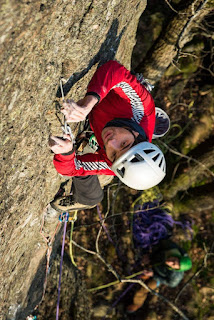
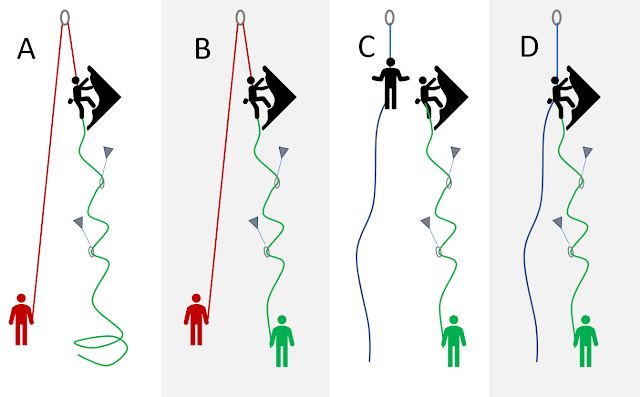
A few weeks ago, I participated as an observer at the pedagogical exam for Rock Climbing Instructors. In the Swedish system (which adheres to UIAA standards), this is the second and final step in testing soon-to-be instructors. It is preceded by a two-day technical exam, so the candidates are already cleared in terms of technical competency. At the pedagogical exam, candidates get to plan and execute, completely independently, a real climbing course with real participants. As an examiner, or in my case observer, this is a fantastic opportunity to spend a weekend watching, analysing, and thinking about various methods used by instructors who have seriously considered every minute of their day. Because the challenge this time was to hold a lead-climbing course, a very specific issue rears its head. How do you teach lead climbing as safely and efficiently as possible? Lead-climbing, after all, requires the student to be on the wall, in exposed terrain. I saw various solutions, all of ...

Epiphany: Clipping the shelf when anchoring off a tree

Image
Epiphanies can be big or small. They can be "Eureka" or "Huh, interesting". It is great that even after decades of climbing I can still get that sudden realization and learn something new. Or maybe it´s just a sign that I have not been paying attention. Anyway, one such epiphany was supplied by John Godino at www.AlpineSavvy.com , who has created a great resource for anything related to wilderness travel and climbing. So, when you wrap sling around a big tree and tie it off, you now have four strands disappearing around the trunk. How would you clip the "shelf"? I found that if I did not give it a second thought, I might clip the two top strands. The reason could be that most anchors involving nuts or cams are usually spread out horizontally, and in these cases we clip the two top (or bottom) strands. But if we do the same with our tree-anchor, we will actually be clipping only one loop, which creates a non-redundant anchor. Here are a few pics to ex...

Tying off a Munther hitch - skip the Mule

Image
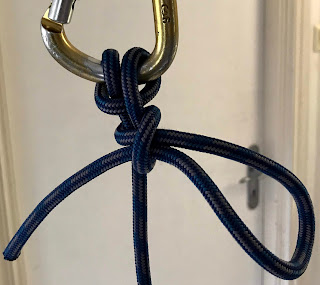
Knots should not just be useful. They need to be easy to teach and hard to get wrong even under stress. A very important skill for any climber is to be able to tie off a belay device or Munther hitch. Whenever you need to get your hands free for a snack, a photo, or transfer loads in a rescue situation, that passive end needs to go somewhere. The classic solution, especially in North America, seems to be the Munther-Mule. It is safe, can be released easily under load, and most importantly, knot nerds (like your average climbing instructor) like complicated knots with unintelligible names. If you are not sure what I mean, here is the Animated Knots page ! The Munther-Mule combination. The backup half hitch has been omitted for clarity. I should start by making it very clear that this is a tried and tested method. Technically, there is nothing wrong with a properly tied Munther-Mule combination, and if you like it, use it! But I strive to teach knots that are easy to use,...

When to talk about the dark side of climbing

Image
People get hurt. People die. Yet climbers will climb and I think this makes the world a better place. So how do we talk about this with our clients? I am not going to provide any answers here, because it is something I wrestle with myself. But I will try to organize my thoughts, and hopefully, this will trigger some input from my readers. The reason we are in this business  - teaching climbers all the survival skills - is that climbing is dangerous. Very dangerous. Every year, lots of people die or get seriously injured in climbing. It seems only natural that we should be transparent about it. Why? Because studying accidents is how we can understand risk, and develop both safety culture and safety technology. On the other hand, ambushing a nervous beginner with tales of death and suffering hardly seems inspirational, does it? What, then, could be the middle ground? I believe that facts and timing matter. Let me explain. The reason we need to talk to students about acciden...

Quick and dirty setup for ascending and descending a fixed instructor´s rope.

Image
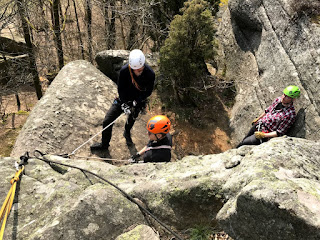
Use the gear you already have, to work efficiently on the wall. This blog was not supposed to be about technical stuff. No gear tests, kilo-Newtons, knots, or steel alloy classification. There´s enough of that on the www already.  But I plan to make exceptions now and then, for either of two reasons: because I want to discuss the truth (or untruth) of something we often teach, or because I want to highlight techniques practical in the instructor´s daily work. In this case, it is the latter. Whenever we have climbers on the wall, we like to have at least one instructor there - to teach, goad, double-check, and provide safety backup. We want to be able to move both up and down, and sometimes even sideways if we are supporting two climbers. What is a good way to achieve this? My buddy Martin (center) during an exam. Note the instructor on the right and his setup. There are many solutions, the most obvious one being to ascend the rope on jumars using regular big-wall tech...

Good pro, bad pro, and real pro

Image
Is that piece of pro good or bad? It´s never that simple.  As an instructor and as an experienced climber, you know that solid gear is crucial to climbing safely. If the nut holds, you are fine. If not, you are in deep trouble, regardless of how expensive your shiny new rope is. So we spend a lot of time trying to convey the importance of perfect gear. Full contact between nut and rock, bomber rock quality, no walking cams... You know the drill. This is all basic and vital knowledge. And it remains true that all gear must be bomber, so long as we are building top rope anchors. If we cannot find three bomber placements, we should simply pack up and find another route, or go home. It´s really that simple. Simon on the first ascent of something horrifying. In lead climbing, however, the waters become muddier. Suddenly, we are in the land of "not great but good enough", "place that nut and move on before pump sets in", "its a crappy little nut but m...

The Bandwidth Problem, or The Importance of Not Teaching

Image
Remember that we are not a circus. Our job is not to show off the maximum number of tricks.  To teach more, sometimes we need to say less. At the end of a two-day course, my voice is always shot, and I croak my goodbyes like an old frog. For many years, I have tried to practise my own philosophy of teaching, and talking, as little as possible. Yet I keep yabbering on. Whatever country or training system you are working within, you probably follow some kind of syllabus. You are expected to tick a number of boxes: anchors, rappelling, knots, climbing technique, access, grading. Check, check, check. Many participants will greedily ingest everything you throw at them. But people are different. If someone is completely new to the exposure, the engineering, the group - then a day or two at a crag is going to wear him down. Stress, cold, individual learning styles, or group dynamics will further affect his capacity to learn. In the end, it is a simple fact that just pulling from...